
 A arm installation, final tightening A arm installation, final tightening |
|
|

|
Porsche, and the Porsche crest are registered trademarks of Dr. Ing. h.c. F. Porsche AG.
This site is not affiliated with Porsche in any way. Its only purpose is to provide an online forum for car enthusiasts. All other trademarks are property of their respective owners. |
|
|
  |

| EJP914 |
 Jan 26 2026, 08:00 AM Jan 26 2026, 08:00 AM
Post
#1
|
|
Member  Group: Members Posts: 283 Joined: 14-June 03 From: Monroeville, PA Member No.: 821  |
Putting A arms back on after installing new bushings.
I think ??? the right way to do the final tighten up to spec is to have the full weight of the car on the suspension. Would it be sufficient to put a jack under the A Arm and jack it up a bit to simulate the car being on the ground (load up the suspension) and then final tighten up? Also, where can I find torque specs for the 3 bolts and 1 Allen type screw that hold the A Arm to the car body? Google gives a bunch of sites with varying numbers. Thanks for the help. ED |
   |

 
|
| DennisV |
Jan 26 2026, 08:35 AM
Post
#2
|
|
Senior Member Group: Members Posts: 846 Joined: 8-August 20 From: Santa Rosa, CA Member No.: 24,575 Region Association: Northern California 
|
QUOTE(EJP914 @ Jan 26 2026, 06:00 AM)  Putting A arms back on after installing new bushings. I think ??? the right way to do the final tighten up to spec is to have the full weight of the car on the suspension. Would it be sufficient to put a jack under the A Arm and jack it up a bit to simulate the car being on the ground (load up the suspension) and then final tighten up? Also, where can I find torque specs for the 3 bolts and 1 Allen type screw that hold the A Arm to the car body? Google gives a bunch of sites with varying numbers. Thanks for the help. ED You can find PDF versions of the Factory Workshop manual online. I think what you're looking for is in Group 4 Front Axle. 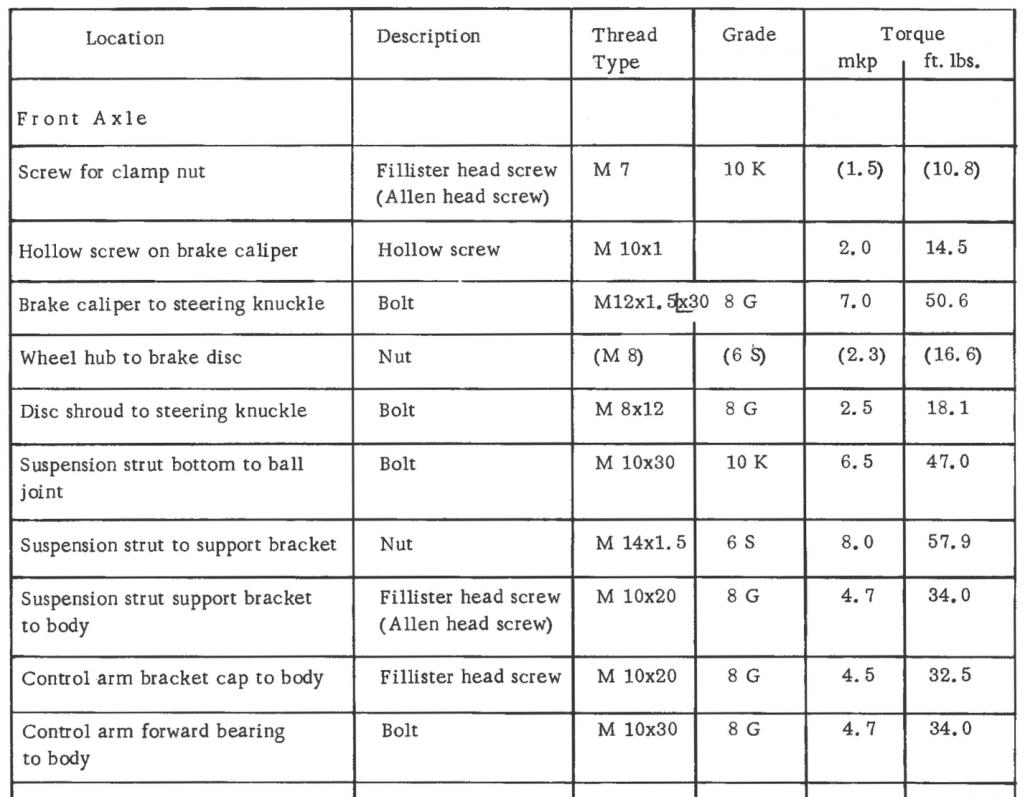 |
 |
|
| Spoke |
Jan 26 2026, 10:25 AM
Post
#3
|
|
Jerry Group: Members Posts: 7,321 Joined: 29-October 04 From: Allentown, PA Member No.: 3,031 Region Association: None
|
Not sure what you mean by final tighten up. All bolts should be secure before putting any stress on the A-arm. The only adjustment should be the ride height but that should be done after a quick trip around the block to settle the suspension. All tires should be at a prescribed pressure and measure the height of the fender on both sides and note the rake of the car from front to rear. Lift the car and adjust the height screw as needed. Retest.
For the most part you will need a front end alignment because raising or lowering the front end will change the toe setting. |
|
|
|
| fiacra |
Jan 26 2026, 11:47 AM
Post
#4
|
|
Person.Woman.Man.Camera.TV. = MCI Group: Members Posts: 679 Joined: 1-March 19 From: East Bay Region - California Member No.: 22,920 Region Association: Northern California
|
QUOTE(Spoke @ Jan 26 2026, 08:25 AM) Not sure what you mean by final tighten up. All bolts should be secure before putting any stress on the A-arm. The only adjustment should be the ride height but that should be done after a quick trip around the block to settle the suspension. All tires should be at a prescribed pressure and measure the height of the fender on both sides and note the rake of the car from front to rear. Lift the car and adjust the height screw as needed. Retest. For the most part you will need a front end alignment because raising or lowering the front end will change the toe setting. Haven't done the A arm bushings on any of my 914s, but on every other car that I've replaced suspension bushings on the protocol is to lightly snug fasteners down then load them before torquing to spec. This is to prevent premature tearing, wear, etc. They need to be in their neutral position as a starting point so they can move within the range they are designed to move as you drive the car. If you fully tighten them down before you load the suspension then as soon as you put weight on them they are already twisted and will not be starting in a neutral position. That will lead to premature failure. You can load the suspension any way you want, including using a jack. Ideally the wheels would be on the ground and the full weight of the car on the suspension, but that's pretty hard to accomplish unless you have the right kind of lift. Can't see why this wouldn't also apply to 914s, but somebody can set me straight if I'm off base on this. It's certainly the way I did it when I replaced the rear trailing arm bushings. |
|
|
|
| Jack Standz |
Jan 26 2026, 02:21 PM
Post
#5
|
|
Senior Member Group: Members Posts: 681 Joined: 15-November 19 From: Happy Place (& surrounding area) Member No.: 23,644 Region Association: None
|
Let's back up a little bit.
When you replace the a-arm bushings, proper procedure is to "clock" the bushing carriers at the correct angle. If you haven't done this, you can create too much stress on the bushing when it is installed with the weight on the car. A-arms with properly clocked bushings just bolt on. Then you adjust ride height with the torsion bar adjusting bolts. And an alignment. |
|
|
|
| Superhawk996 |
Jan 26 2026, 02:54 PM
Post
#6
|
|
914 Guru Group: Members Posts: 7,653 Joined: 25-August 18 From: Woods of N. Idaho Member No.: 22,428 Region Association: Galt's Gulch
|
QUOTE(Jack Standz @ Jan 26 2026, 04:21 PM) Let's back up a little bit. When you replace the a-arm bushings, proper procedure is to "clock" the bushing carriers at the correct angle. If you haven't done this, you can create too much stress on the bushing when it is installed with the weight on the car. A-arms with properly clocked bushings just bolt on. Then you adjust ride height with the torsion bar adjusting bolts. And an alignment. (IMG:style_emoticons/default/agree.gif) |
|
|
|
| SirAndy |
Jan 26 2026, 02:56 PM
Post
#7
|
|
Resident German Group: Admin Posts: 42,416 Joined: 21-January 03 From: Oakland, Kalifornia Member No.: 179 Region Association: Northern California |
QUOTE(Jack Standz @ Jan 26 2026, 12:21 PM) Let's back up a little bit. When you replace the a-arm bushings, proper procedure is to "clock" the bushing carriers at the correct angle. If you haven't done this, you can create too much stress on the bushing when it is installed with the weight on the car. A-arms with properly clocked bushings just bolt on. Then you adjust ride height with the torsion bar adjusting bolts. And an alignment. Another thing i like to do is, with the struts disconnected and the torsion bars removed, torque the a-arms down and then make sure they move more or less freely without too much stiction from the bushings. I once had sticking bushings that added so much stiction to the a-arms that my spring rate went through the roof resulting in a very harsh and borderline dangerous ride quality. (IMG:style_emoticons/default/huh.gif) PS: This test will also expose any accident damage to the chassis that might be hiding there. A bent chassis will result in the a-arms getting into a bind when torqued down, again resulting in extra stiction. |
|
|
|
| fiacra |
Jan 26 2026, 04:52 PM
Post
#8
|
|
Person.Woman.Man.Camera.TV. = MCI Group: Members Posts: 679 Joined: 1-March 19 From: East Bay Region - California Member No.: 22,920 Region Association: Northern California
|
QUOTE(Jack Standz @ Jan 26 2026, 12:21 PM) Let's back up a little bit. When you replace the a-arm bushings, proper procedure is to "clock" the bushing carriers at the correct angle. If you haven't done this, you can create too much stress on the bushing when it is installed with the weight on the car. A-arms with properly clocked bushings just bolt on. Then you adjust ride height with the torsion bar adjusting bolts. And an alignment. Got it. That makes sense. (IMG:style_emoticons/default/beerchug.gif) |
|
|
|
| EJP914 |
Jan 26 2026, 04:53 PM
Post
#9
|
|
Member Group: Members Posts: 283 Joined: 14-June 03 From: Monroeville, PA Member No.: 821 |
Many thanks for the replies.
Thanks for the torque spec chart. What I meant by final tighten up was to get the bolts tightened to spec. Right now they are tight but probably not close to spec. Maybe even a bit too tight. I did "index" the front and rear brackets that hold the bushings when I installed them. I marked the height adjustment screw with some paint before i removed it so I should be close to where the car was once its back on the ground. Probably have to fuss with it some. I don't think i should need realignment since i did not loosen any of the top strut mounting bolts and not removing the caliper and dust shield made things a little interesting when trying to get the lower ball joint into the strut hole. Gonna jack up the A arm for some suspension loading and tighten to spec. Never did this before. Wasn't that bad of a job. |
|
|
|
|

|
Lo-Fi Version | Time is now: 26th January 2026 - 05:23 PM |
Invision Power Board
v9.1.4 © 2026 IPS, Inc.