

 To disable cooling flaps or not, The endless debate To disable cooling flaps or not, The endless debate |
|
|

|
Porsche, and the Porsche crest are registered trademarks of Dr. Ing. h.c. F. Porsche AG.
This site is not affiliated with Porsche in any way. Its only purpose is to provide an online forum for car enthusiasts. All other trademarks are property of their respective owners. |
|
|
  |
| Superhawk996 |
 Jun 7 2026, 04:45 PM Jun 7 2026, 04:45 PM
Post
#1
|
|
914 Guru  Group: Members Posts: 7,885 Joined: 25-August 18 From: Woods of N. Idaho Member No.: 22,428 Region Association: Galt's Gulch 
 |
QUOTE(Superhawk996 @ Jun 5 2026, 11:33 AM)  QUOTE(930cabman @ Jun 5 2026, 11:07 AM) ditch the stat. Cabman - love ya to death but please stop propagating the ditch the thermostat advice. The flaps and thermostat are there for a reason. The majority of engine wear occurs during the warmup phase of operation this is true of all engines and is backed by decades of SAE research and documentation. Disabling flaps and delaying warmup results in accelerated wear. Even worse, air cooled engines depend on expansion of the heads to increase clamp load between the cylinder and the head as the engine heats up. Delaying warmup results in more likelihood of blowby between the head and cylinder and between the cylinder and the case. And even worse yet on a carbureted car where the delayed warmup reduces fuel atomization, and increases cylinder wash down - really accelerating wear and diluting oil. I’ve read all the anecdotal stuff of “my engine is fine”. You may think so but the reality is you are only looking at a tiny snapshot in time of the engine life and wear. As a hobbyist, you likely won’t ever have the opportunity to compare engine life of engine A that ran properly vs engine B that has the flaps disabled. And I’ll concede that because a hobby car only gets driven infrequently - that partially negates the wear argument(s). But let’s not keep propagating the shade tree mindset that the thermostat & flaps aren’t necessary for proper operation and longevity of T4 engines. Once he’s in there deep enough to identify the cause, it should be fixed properly not jury rigged. |
   |

 
|
| Superhawk996 |
Jun 7 2026, 04:46 PM
Post
#2
|
|
914 Guru Group: Members Posts: 7,885 Joined: 25-August 18 From: Woods of N. Idaho Member No.: 22,428 Region Association: Galt's Gulch
|
QUOTE(Superhawk996 @ Jun 7 2026, 01:34 PM) QUOTE(930cabman @ Jun 7 2026, 10:38 AM) QUOTE(930cabman @ Jun 5 2026, 11:53 AM) I am fully onboard of the fact the Germans wouldn't include anything not 100% necessary, but I only have my own experience. My recent (3 years ago) 2056 build rocks, heats up very quickly, runs down the road at 80mph at 210-230 F oil temp getting 30+mpg. NO thermostat, flaps fully open 24-7-365 I'm waiting (IMG:style_emoticons/default/stirthepot.gif) For what? Permission to wear out your engine prematurely? Granted. (IMG:style_emoticons/default/stirthepot.gif) Having been an automotive engineer by profession (30 years) we can start a new thread on it. We can go thru various SAE papers as well as the Mackerle book Air-Cooled Automotive Engines if you want. Just for clarity, I love debating this (IMG:style_emoticons/default/stromberg.gif) and have posted the the response above out of good natured friendship / ribbing (IMG:style_emoticons/default/poke.gif) and don’t mean for it to be mean or dismissive. Happy to have the debate with anyone but let’s not tie up Ron’s thread. (IMG:style_emoticons/default/drunk.gif) |
|
|
|
| Superhawk996 |
Jun 7 2026, 04:47 PM
Post
#3
|
|
914 Guru Group: Members Posts: 7,885 Joined: 25-August 18 From: Woods of N. Idaho Member No.: 22,428 Region Association: Galt's Gulch
|
QUOTE(930cabman @ Jun 7 2026, 04:39 PM) Having results for the OP is the goal, in my opinion it is far better to have flaps wide open than flaps closed or possibly (partially)closed again, in 45 - 50 degree ambient my 2056 is defrosting the windshield in a very short time, just my .02 hope Ron can get to the bottom of things |
|
|
|
| Superhawk996 |
Jun 7 2026, 04:55 PM
Post
#4
|
|
914 Guru Group: Members Posts: 7,885 Joined: 25-August 18 From: Woods of N. Idaho Member No.: 22,428 Region Association: Galt's Gulch
|
@930cabman
Here’s the thing. The defroster performance has absolutely nothing to do with engine warmup. The defroster performance is based on the heat exchangers obtaining heat from the engine exhaust heat. Regardless of the overall engine operating temperature, the exhaust gas exiting the combustion chamber is in excess of 600-800F almost instantaneously. Just because you have heat doesn’t mean the engine is at operating temperature. You also keep going back to the analogy of your engine. Engine wear from running cold doesn’t manifest immediately. Unless you have multiple engines that have been run to failure or end of life to compare to a singular data point of your engine at a few thousand miles is practically meaningless. How many miles on your engine? I think we both want the same thing for Ron, a functional car to drive. The thing is for him to disable the flaps, he would still need to drop the engine and resolve what ever is limiting his flap movement and preventing them from getting to full open. |
|
|
|
| emerygt350 |
Jun 7 2026, 05:04 PM
Post
#5
|
|
Advanced Member Group: Members Posts: 3,634 Joined: 20-July 21 From: Upstate, NY Member No.: 25,740 Region Association: North East States |
It's such a simple and clever device, why not have it functioning correctly? Also, if you are running djet you really do want that engine getting up to operating temperatures. Although the system can handle colder engine temps it doesn't do it particularly well. During the colder driving months in NY you can end up running cold enough that it will richen the mix etc if you don't have a functioning thermostat. When my cable broke this spring it caused all kinds of strange engine behavior until I figured out what had happened. Certainly not an issue in southern California but a functioning system is still better than cold oil and a rich mix washing down cylinder walls.
|
 |
|
| 930cabman |
Jun 7 2026, 06:08 PM
Post
#6
|
|
Advanced Member Group: Members Posts: 4,702 Joined: 12-November 20 From: Buffalo Member No.: 24,877 Region Association: North East States
|
QUOTE(Superhawk996 @ Jun 7 2026, 04:55 PM) @930cabman Here’s the thing. The defroster performance has absolutely nothing to do with engine warmup. The defroster performance is based on the heat exchangers obtaining heat from the engine exhaust heat. Regardless of the overall engine operating temperature, the exhaust gas exiting the combustion chamber is in excess of 600-800F almost instantaneously. Just because you have heat doesn’t mean the engine is at operating temperature. You also keep going back to the analogy of your engine. Engine wear from running cold doesn’t manifest immediately. Unless you have multiple engines that have been run to failure or end of life to compare to a singular data point of your engine at a few thousand miles is practically meaningless. How many miles on your engine? I think we both want the same thing for Ron, a functional car to drive. The thing is for him to disable the flaps, he would still need to drop the engine and resolve what ever is limiting his flap movement and preventing them from getting to full open. Point made, if I can get it on the list I should probably just get er done. And yes, defrost has little to do with engine temps To Ron's issue, I was hopeful the tin could be removed in place but I have never attempted this operation. Surely this work is much simpler with the engine on the bench. Is the consensus his overheating is due to closed flaps? |
|
|
|
| JamesM |
Jun 7 2026, 06:48 PM
Post
#7
|
|
Advanced Member Group: Members Posts: 2,242 Joined: 6-April 06 From: Kearns, UT Member No.: 5,834 Region Association: Intermountain Region |
I think you both have points that are valid to some extent, but I think context has been left out of the discussion.
Here are some of my thoughts on it: First I agree that I don't think the Germans put unnecessary parts on the car. That said though they built a car that was intended to be used in ways and across a wide range of environments that I don't think a whole lot of 914 owners actually use them in anymore. A winter in Germany and a summer in Southern California have different requirements. At this point I think most if not all 914 owners avoid even driving in the rain, let alone sub 20 degrees and snowing. Why is this relevant? Well, living in Utah and having driven 914s in conditions that are more extreme on both end of the spectrum I have some data points to add. Specifically on a 100 degree day in summer I wont ever see the thermostat closed, but in the winter say cruising down the mountain in 10 degree weather, I wont see it ever open, AND even then its a fight to keep temp in the heads. So. My personal opinion is that it is BETTER to have the thermostat installed and working, or at least there is not a downside to it because that gives you the best possible outcome under all conditions. BUT given most 914 owners are not driving in conditions that would keep the thermostat closed while driving and that the time it actually spends closed even on startup in hot weather is minimal its probably not the end of the world to go without it. Unless of course you plan on driving down mountain roads in a Utah winter in which case you absolutely want it functioning. Having the air flaps installed properly though is ALWAYS a must. IDK where anyone got the idea that it was ok to remove the flaps completely but I have seen that done more than a few times. |
|
|
|
| Jack Standz |
Jun 7 2026, 07:43 PM
Post
#8
|
|
Senior Member Group: Members Posts: 823 Joined: 15-November 19 From: Happy Place (& surrounding area) Member No.: 23,644 Region Association: None
|
QUOTE(930cabman @ Jun 8 2026, 07:08 AM) To Ron's issue, I was hopeful the tin could be removed in place but I have never attempted this operation. Surely this work is much simpler with the engine on the bench. Is the consensus his overheating is due to closed flaps? Years ago, we did remove the driver's side tin with the motor still in the car. Last year after somebody (not me) dropped a spark plug wrench in the driver's side tin, we partially removed a driver's side tin to remove it. It is not a particularly fun job to stand on your head and remove these tins (and on a FI motor probably more will be necessary to remove). However, by using a video camera, you might figure out what is preventing the flaps from operating properly. If so, you might not need to fully remove the tins to fix the problem (maybe there's a flap bushing that is binding or the flap linkage isn't right). Don't know if this is a good one, but it or a similar one is about $21: https://www.amazon.com/Endoscope-Adjustable...r=8-15&th=1 You might also find there are some missing tin pieces (the mystery tin and the tin above the pushrod tubes, etc). Once you diagnose the problem adequately, then you can decide how to proceed with the fix (either in-car or pull the motor). |
|
|
|
| Superhawk996 |
Jun 7 2026, 08:09 PM
Post
#9
|
|
914 Guru Group: Members Posts: 7,885 Joined: 25-August 18 From: Woods of N. Idaho Member No.: 22,428 Region Association: Galt's Gulch
|
QUOTE(JamesM @ Jun 7 2026, 08:48 PM) BUT given most 914 owners are not driving in conditions that would keep the thermostat closed while driving and that the time it actually spends closed even on startup in hot weather is minimal its probably not the end of the world to go without it. James - I largely agree with your position in a pragmatic sense. Nothing is black and white. The accelerated engine wear isn’t immediately perceptible and will only be evident over the (shortened) life of the motor However what frustrates the hell out of me is the continued reliance in these threads on one off anecdotal accounts. “My car” or “I saw”. Here’s the thing. Cold start and warmup wear has been studied extensively by the OEM’s using radiographic techniques to monitor engine component wear during start and warmup operation. There is extensive dyno testing and end of life tear down analysis to know with certainty that not operating in the desired temp range shortens engine life. It just isn’t debatable. I personally used to attend end of life teardowns, warranty failures, and multiple life (200,000 - 300,000 mile motors) about once a month early in my career. You can defiantly tell the engines that were abused by lack of maintenance, sludged oil, and granny cycle (short trips that never come up to operating temp). I’ll be happy to start posting some SAE paper numbers going back to the 50’s. But the reality is they are $39/paper to download and I can no longer get them for free at work since I’ve retired. Would anyone here simply take the thermostat out of your daily driver? I mean after all, if people believe it really doesn’t hurt . . . (IMG:style_emoticons/default/poke.gif) Why have it there to potentially fail. The thermostat on a 914 is no different. The 914 thermostat when operating properly isn’t a binary thing that is just open or closed. The 914 thermostat modulates to keep engine temp in a desired range just like a water pumper thermostat. And as far as the wholesale removal of the flaps, it seems that at least is well enough understood that we aren’t seeing the complete removal that we used to see in the 80s & 90s. |
|
|
|
| Superhawk996 |
Jun 7 2026, 10:19 PM
Post
#10
|
|
914 Guru Group: Members Posts: 7,885 Joined: 25-August 18 From: Woods of N. Idaho Member No.: 22,428 Region Association: Galt's Gulch
|
QUOTE(930cabman @ Jun 7 2026, 08:08 PM) Is the consensus his overheating is due to closed flaps? In all fairness I don’t think we know what is going on with Ron’s flaps and won’t until he’s able to remove the tin. We do know that he doesn’t have a full range of flap motion and his limited travel implies that the flaps aren’t getting to the full open position. In fact I would not even go so far as to say Ron’s car is overheating. To date he’s done a good job of keeping the engine oil temp well below 250F by limiting drive time. But it does seem that it warms the oil abnormally fast as if the oil cooler air flow is being bypassed by closed (or partially closed) flaps. Similarly Ron has been having issues with his cylinder head temp gauge so I don’t think we have a good read on CHT vs oil temp. That is why I have pushed back against the idea of eliminating the thermostat and jury rigging. Until he is able to either drop the engine or get a borescope into the tin, we don’t know. Regardless, my intent of moving this discussion over here is to have an open conversation about thermostats and flaps without bogging down Ron’s thread or confusing his topic with the debate about why the thermostat and flaps were put there in the first place. I have an engine that came to me without flaps. I’ll resist posting those photos here but they aren’t pretty. Per my previous comment to James, I hope we are well past the mythology of the 80s and 90s that the flaps aren’t needed. |
|
|
|
| JamesM |
Jun 7 2026, 11:41 PM
Post
#11
|
|
Advanced Member Group: Members Posts: 2,242 Joined: 6-April 06 From: Kearns, UT Member No.: 5,834 Region Association: Intermountain Region |
QUOTE(Superhawk996 @ Jun 7 2026, 06:09 PM) Would anyone here simply take the thermostat out of your daily driver? I mean after all, if people believe it really doesn’t hurt . . . (IMG:style_emoticons/default/poke.gif) Why have it there to potentially fail. The thermostat on a 914 is no different. The 914 thermostat when operating properly isn’t a binary thing that is just open or closed. The 914 thermostat modulates to keep engine temp in a desired range just like a water pumper thermostat. Having driven both water cooled cars and 914s with failed thermostats there is an observable difference in their temperature control behavior. In my experience when a water cooled thermostat fails the engine never fully comes up to temp, even in the middle of summer. This for sure will cause ongoing accelerated wear, bad gas mileage, etc. In warm weather, I haven't seen that a 914 comes up to temp noticeably slower with a broken thermostat. In the middle of a Utah winter it absolutely does but when thermostats have failed on me in the summer, I don't even notice their failure unless im physically inspecting the engine. the 914 thermostat is a lot more impacted by ambient temperature possibly due to the 914 thermostats placement more or less in ambient air. Yes they modulate temperature but the range in which this modulation occurs only seems to exist at colder ambient temps. Again though, no one should intentionally remove a working thermostat, it accomplishes nothing positive. I'm just saying if your thermostat fails in the middle of summer it probably isnt reason to stop driving your 914 until you can source a replacement. Given its going to take most people 20 years to put 100k on their 914s these days and things like carb conversions, worn out d-jet setups, cylinder cooling fins that have never been cleaned, missing engine tin grommets, etc are contributing far more to engine internal wear than an extra 60 seconds of warm up time. |
|
|
|
| Jack Standz |
Jun 8 2026, 02:44 AM
Post
#12
|
|
Senior Member Group: Members Posts: 823 Joined: 15-November 19 From: Happy Place (& surrounding area) Member No.: 23,644 Region Association: None
|
Thermostats were left off 914s and type iv motors for probably lots of reasons that included lack of understanding about what the T-stat's purpose was, how to install it, etc. Not to mention that many T-stats failed and people didn't recognize that it had failed. Added to that was the fact that you couldn't find a replacement T-stat.
Then along came Awesome Powdercoat with new T-stats that had been unavailable for years. (IMG:style_emoticons/default/aktion035.gif) Problem is the ones from VW of Mexico T-stats fail UNSAFE and will likely overheat/destroy your motor when they fail (IMG:style_emoticons/default/sad.gif). At least the stock ones failed SAFE. We still have some working stock T-stats in the hoard, but over the years of scouring parts yards, they just don't show up and haven't for lots of years. So, is it better to have an UNSAFE T-stat, a broken stock one, or none? (IMG:style_emoticons/default/stirthepot.gif) |
|
|
|
| Superhawk996 |
Jun 8 2026, 07:15 AM
Post
#13
|
|
914 Guru Group: Members Posts: 7,885 Joined: 25-August 18 From: Woods of N. Idaho Member No.: 22,428 Region Association: Galt's Gulch
|
QUOTE(JamesM @ Jun 8 2026, 01:41 AM) the 914 thermostat is a lot more impacted by ambient temperature possibly due to the 914 thermostats placement more or less in ambient air. Yes they modulate temperature but the range in which this modulation occurs only seems to exist at colder ambient temps. Here’s the thing - what you observe while the car is sitting static isn’t the same as what’s going on while driving. Because the bellows is largely in the ambient air steam it is getting much cooler airflow while driving (partially closing flaps) than when you see it while then vehicle is sitting static and only getting hot engine air from above. Sure on a 100+ day - once warned it won’t modulate much. However, don’t overestimate the number of cars being driven in 100F + temps especially those without A/C. |
|
|
|
| Superhawk996 |
Jun 8 2026, 07:16 AM
Post
#14
|
|
914 Guru Group: Members Posts: 7,885 Joined: 25-August 18 From: Woods of N. Idaho Member No.: 22,428 Region Association: Galt's Gulch
|
QUOTE(JamesM @ Jun 8 2026, 01:41 AM) Again though, no one should intentionally remove a working thermostat, it accomplishes nothing positive. I'm just saying if your thermostat fails in the middle of summer it probably isnt reason to stop driving your 914 until you can source a replacement. (IMG:style_emoticons/default/agree.gif) |
|
|
|
| Superhawk996 |
Jun 8 2026, 07:23 AM
Post
#15
|
|
914 Guru Group: Members Posts: 7,885 Joined: 25-August 18 From: Woods of N. Idaho Member No.: 22,428 Region Association: Galt's Gulch
|
QUOTE(Jack Standz @ Jun 8 2026, 04:44 AM) So, is it better to have an UNSAFE T-stat, a broken stock one, or none? (IMG:style_emoticons/default/stirthepot.gif) Well, we’ve reached the point in the program where the strawman arguments appear (IMG:style_emoticons/default/stirthepot.gif) You would be better off adapting the failsafe VW Bug thermostat with its lower opening temperature than nothing. You would be better off adapting a Corvair thermostat with its different mounting than nothing. I agree there was a period in time where it was difficult to find a good T4 thermostat. However there has never been a period of time where it was impossible. If people want to knowingly make the decision to run without a thermostat; I’m not going to try to stop them. My only goal here is to get people to recognize that they are reducing their engine life by doing so. |
|
|
|
| Superhawk996 |
Jun 8 2026, 07:27 AM
Post
#16
|
|
914 Guru Group: Members Posts: 7,885 Joined: 25-August 18 From: Woods of N. Idaho Member No.: 22,428 Region Association: Galt's Gulch
|
It seems to me that you guys haven’t yet come to terms with how real and how apparent wear is (when measured) as it relates to temperature. In these charts keep in mind this is cylinder temp, not cylinder head temp.
So let’s put up a couple charts on how engine temp affects wear and how much wear occurs when the engine temp is transitioning. 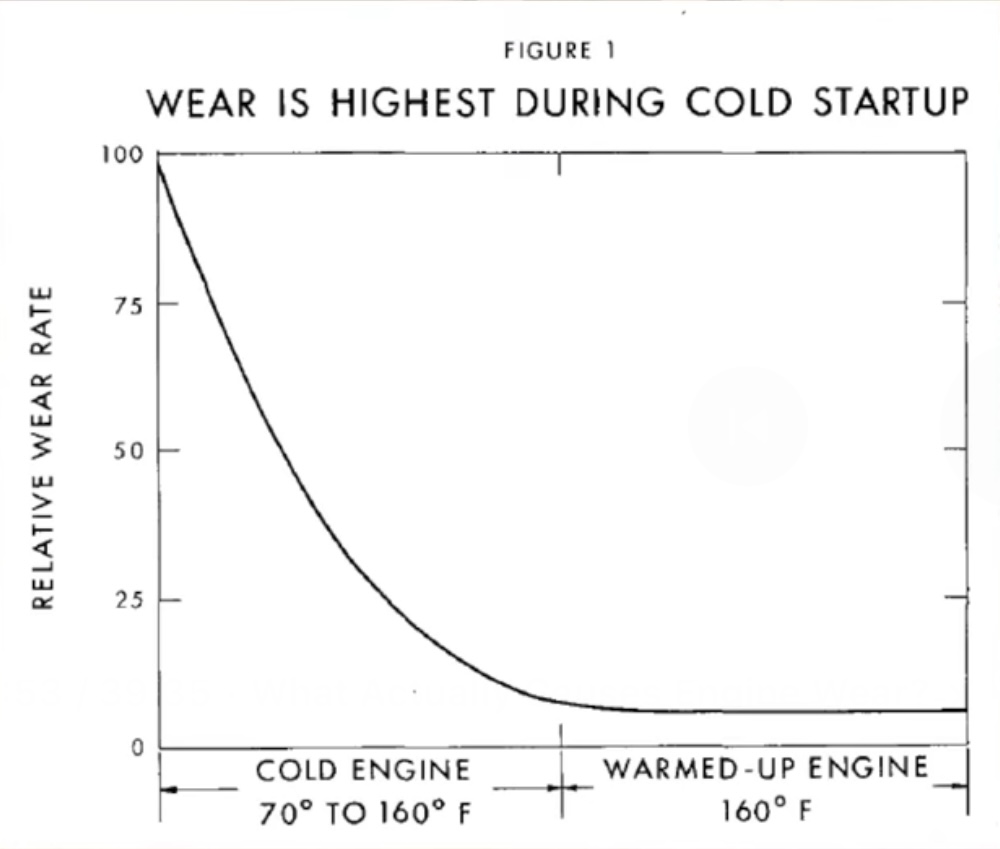 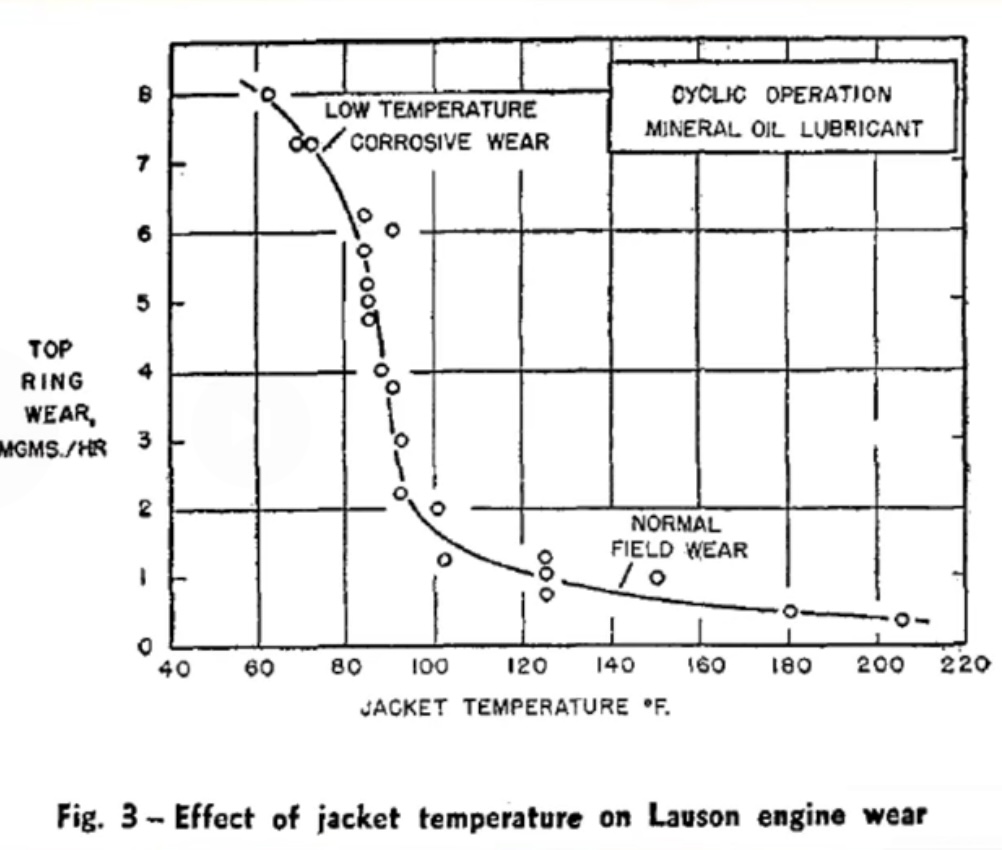 This 3rd chart is a GM study that shows ring wear on an already running engine accelerate as the coolant temp and oil sump temperate on a dyno is reduced about 1/2 way through the test. Toward the very end of the test the coolant and sump temperate is again raised and the ring wear levels off / stabilizes. 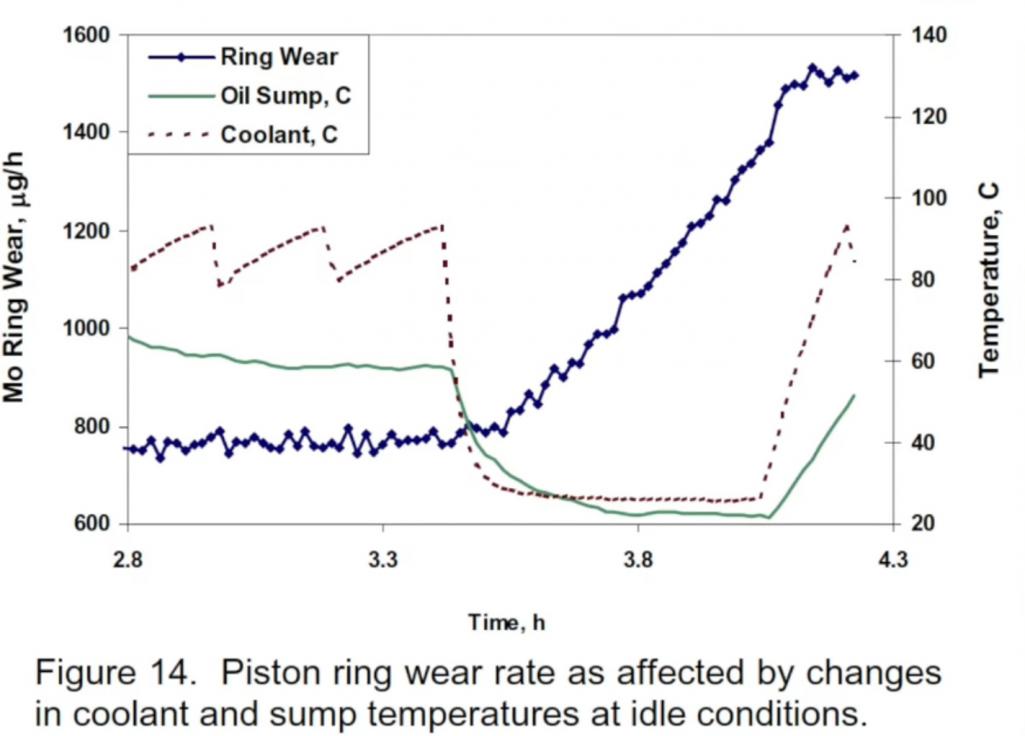 Just to reiterate, I’m not saying the wear is instantaneously going to destroy your engine. However this shadetree mindset that “I haven’t seen” any reduced life is a fallacy. Without a baseline engine that was operated properly for its life to compare against your engine , you’ll never know exactly how much your particular engine life was shortened. As long as you accept that, do what you want. However - advising others to take on that accelerated wear without informing them about the wear trade off isn’t fair to those that might not know any better. |
|
|
|
| JamesM |
Jun 8 2026, 07:36 AM
Post
#17
|
|
Advanced Member Group: Members Posts: 2,242 Joined: 6-April 06 From: Kearns, UT Member No.: 5,834 Region Association: Intermountain Region |
QUOTE(Superhawk996 @ Jun 8 2026, 05:23 AM) QUOTE(Jack Standz @ Jun 8 2026, 04:44 AM) So, is it better to have an UNSAFE T-stat, a broken stock one, or none? (IMG:style_emoticons/default/stirthepot.gif) You would be better off adapting the failsafe VW Bug thermostat with its lower opening temperature than nothing. Probably want to be very explicit here given this is the internet (IMG:style_emoticons/default/biggrin.gif) by failsafe Bug thermostat I assume you are referring to the stock German accordion style and not the Mexican style that most people know to avoid (not all people know to avoid them however as we ripped one off a car a couple months ago) Also posting again for those that don't know they exist... https://www.awesomepowdercoat.com/porsche-thermostats |
|
|
|
| Superhawk996 |
Jun 8 2026, 08:10 AM
Post
#18
|
|
914 Guru Group: Members Posts: 7,885 Joined: 25-August 18 From: Woods of N. Idaho Member No.: 22,428 Region Association: Galt's Gulch
|
QUOTE(JamesM @ Jun 8 2026, 09:36 AM) by failsafe Bug thermostat I assume you are referring to the stock German accordion style and not the Mexican style that most people know to avoid (not all people know to avoid them however as we ripped one off a car a couple months ago) Also posting again for those that don't know they exist... https://www.awesomepowdercoat.com/porsche-thermostats Yes, thank you. I wouldn’t want anyone using the the Mexican version. To capitulate to Jack Standz - I would run no thermostat before I’d run the Mexican part . . . Until I could locate a T4 thermostat or any of the other alternative I referred to. Let’s put this link to the various thermostat operating temps here too. https://www.awesomepowdercoat.com/vw-thermostats |
|
|
|
| era vulgaris |
Jun 8 2026, 08:22 AM
Post
#19
|
|
J is for Genius Group: Members Posts: 987 Joined: 10-November 13 From: Raleigh, NC Member No.: 16,629 Region Association: South East States |
QUOTE(Superhawk996 @ Jun 8 2026, 09:15 AM) QUOTE(JamesM @ Jun 8 2026, 01:41 AM) the 914 thermostat is a lot more impacted by ambient temperature possibly due to the 914 thermostats placement more or less in ambient air. Yes they modulate temperature but the range in which this modulation occurs only seems to exist at colder ambient temps. Because the bellows is largely in the ambient air steam But, it's not actually supposed to be in the ambient air stream. On ACVW's it's protected from the ambient air stream by the sled tins, and on 914's it's protected from the ambient air stream by the lower engine tin (the angular looking one with the half-cylindrical indent for the shift rod). However since these lower tins are missing from most 914's, the thermostat ends up in ambient air where it really was never meant to be. I still 100% agree that all of these parts need to be there (just got in this same discussion recently on the samba because alot of people don't understand how critical a fast engine warm up is), but if you want the system working exactly as it should, that lower engine tin also needs to be in place. |
|
|
|
| JamesM |
Jun 8 2026, 08:50 AM
Post
#20
|
|
Advanced Member Group: Members Posts: 2,242 Joined: 6-April 06 From: Kearns, UT Member No.: 5,834 Region Association: Intermountain Region |
QUOTE(Superhawk996 @ Jun 8 2026, 05:27 AM) It seems to me that you guys haven’t yet come to terms with how real and how apparent wear is as it relates to temperature. In these charts keep in mind this is cylinder temp, not cylinder head temp. I'm 100% on board with the wear data, this is the reason I had guys replacing thermostats almost constantly while I was at PMB. Id say roughly one in three was coming in with a broken one. The data points I am adding though (that can also be applied to these charts) is that a "cold start" here at least during the majority of the driving season is generally near if not over 100F+ and that the time to get to 160+ with or without a working thermostat isnt really much different. Assuming at least you are not holding 3k+ rpm immediately after startup. There just isnt enough cooling capacity at idle fan speeds in 100deg ambient (with the asphalt sitting 140-160) to meaningfully slow that process. Air-cooled motors don't have to heat a volume of coolant like a water cooled motor does so this process happens faster and they are not fighting the extra thermal mass due to a broken thermostat in the way water cooled motors do. The regulation of the cooling system on Type 4s is not incredibly accurate to begin with given that there is no thermostat impacted by oil temperature. The only thing regulating oil flow though the cooler is a pressure bypass and the thermostat controlling air flow through the cooler is on the opposite side of the motor from that cooler only getting the airflow off of the 1-2 cylinders. The flaps/thermostat help the system get up to temp quicker in cold weather but the flaps are generally going to be in the full hot position and blowing air over the oil cooler before the oil is up to temp anyways given how much faster the heads and cylinders heat up vs the oil. The wear data is valid, but I don't think even in the best case scenario the type 4s cooling system is fully optimized to take the best advantage of that. |
|
|
|
|
3 User(s) are reading this topic (3 Guests and 0 Anonymous Users)
0 Members:

|
Lo-Fi Version | Time is now: 13th June 2026 - 05:28 AM |
Invision Power Board
v9.1.4 © 2026 IPS, Inc.